Thursday, June 4, 2015

Politically Incorrect Fun

It is fun to imagine the years of my Mom and Dad's courtship and early marriage when health and vigor allowed them to enjoy roller skating together. I've heard they were quite talented and could dance and twirl with style and finesse around the rink on their skates.

This picture helps me envision them in each others arms during those years. Anyone can see that they were in love.

Mom had a fun sense of humor and an infectious laugh. The year prior to meeting Dad, the singer Arthur Godfrey had a surprise hit record with the novelty song, "Too Fat Polka (She's Too Fat For Me)".
We had the 78 rpm record on this crazy song and often played it when I was small, while Mom sang along to the goofy lyrics:

Here's a silly ditty,
You can sing it right away.

Now, here is what you say

So sing it while you may.


Here's a silly jingle,

You can sing it night or noon.

Here's the words, that's all you need

'Cause I just sang the tune:


Oh, I don't want her, you can have her

She's too fat for me.

She's too fat for me,

She's too fat for me.

I don't want her, you can have her,

She's too fat for me,

She's too fat,

She's too fat,

She's too fat for me.


I get dizzy,

I get numbo,

When I'm dancing

With my Jum-Jum-Jumbo.


I don't want her, you can have her

She's too fat for me.

She's too fat for me,

She's too fat for me.

I don't want her, you can have her

She's too fat for me.

She's too fat,

She's too fat,

She's too fat for me.


Can she prance up a hill?

No, no, no, no, no.

Can she dance a quadrille?

No, no, no, no, no.

Does she fit in your coupe?

By herself she's a group.

Could she possibly

Sit upon your knee?

No, no, no.


We don't want her, you can have her

She's too fat for me.

And she's too fat for me,

But she's just right for me.

We don't want her, you can have her

She's too fat for me.

Yeah, she's too fat,

Much too fat,

But she's just right for me.


She's so charming

And she's so winning,

But it's alarming

When she goes in swimming.


We don't want her, you can have her

She's too fat for me.

She's too fat for me,

But she's just right for me.

So I sure want her, you can't have her

She's just right for me.

But she's too fat!

She's not too fat!

She's just right for me!


She's a twosome,

She's a foursome.

If she'd lose some

I would like her more some.


I don't want her, you can have her

She's too fat for me.

She's too fat for me,

She's too fat for me.

I don't want her you can have her

She's too fat for me.

She's too fat,

Much too fat,

She's too fat for me.

Hey!


Wednesday, June 3, 2015

The Happiest Place on Earth

Grandma (Ethel Hurst Speas) lived in the happiest place on earth. Nope, not Disney Land, Grandma's houseShe shared the charm and magic of Walt Disney, but her budget was much smaller than his. Just as I'll never tire of the original rides at Disneyland, I never grew bored with the simple pleasures at Grandma's house. If you didn't have the joy of spending time in her small Woodville home, you missed out, big time. 

You entered her house through a porch area with a squeaky, cracked linoleum floor. The porch wasn't heated, so it was the perfect place for the big chest freezer, which was very conveniently located so that Grandma could give guests a bottle of freezer jam as they went out the door to go home. She also kept delicious butterscotch fudge in a mason jar in the freezer. She would give us a piece on our way out. I wonder if that was planned so that sticky fingers were in the car, not her house? Come to think of it, this fudge may have been the reason she never replaced the squeaky floor; there was no way you could have ever snatched a piece undetected. I'm not sure I've ever eaten thawed butterscotch fudge, I simply could not wait.

A small bookcase on the porch held a few odd titles, including "Ripley's Believe It or Not" and a stack of old copies of the Friend magazine. A little basket filled with seashells was on the top shelf. Grandma had saved them from a visit to Virginia Beach many years before. They were special to her and a novelty to a little Idaho girl who had never seen the ocean.

On the wall just inside the front room door hung a creepy picture of a cupid with a bow and arrow. That painting haunted more than one dream. It was in an oval frame with concave glass. This may not be it exactly, but it was similar. I had a strange fascination with the cupid, but I never thought to ask what it was or why it was there. Someday I'll ask Grandma.  The wall paper over the couch was a busy flower pattern and on the arms and back of the chairs and couch doilies were stretched to protect the upholstery (or cover threadbare areas). A shortening can filled with skeins of thread and tubes of  seed beads for making doilies was always kept handy for Grandma to grab and work on in spare moments.

If you visited on a weekday, you would often find the front room filled with a quilt on stands that stretched the pieced top and batting from wall to wall. Quilters on the far side had to sit on the couch because there wasn't room to pull up kitchen chairs on all sides. Under the quilt was a great place to play with Grandma's toys. The toys were held inside the lower doors of the breakfront. Here are a few I remember:

The button bottle: There were many things that could be done with the large jar filled with mismatched buttons. Little hands could string them in interesting patterns on a piece of yarn threaded through a large darning needle. Then it could be tied off with a knot and worn as a beautiful necklace. At the end of the visit though, the buttons went back in the bottle, not home, so they could be used by the next friend.

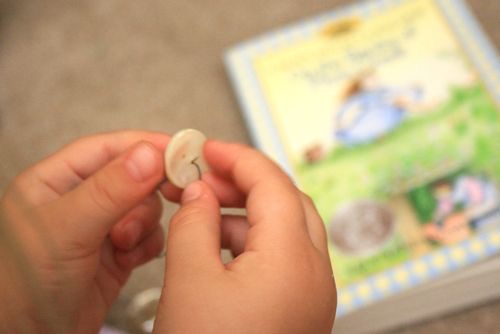
Buttons and string could also be used to make a dancing button, or buzz saw toy, depending upon if the participant was a girl or a boy. In either case, you needed a button with two eyes and a long piece of string. You would thread the button as in the picture and then, putting your fingers through the end loops, whirl it around and then pull your hands apart and bring them close together over and over again. It you spun it fast enough it would make a whirring sound and would spin into a pretty illusion, especially if you used a fancy button.

String could be a toy all by itself. If you were lucky enough to have a willing cousin there, string games could by played by two. Or, if you were alone, no problem, Jacobs Ladder and other string figures and tricks were fun to play by yourself. My favorite trick was one in which the loop of string was twisted in what looked like a tangled mess around the fingers, and then by pulling a particular string, everything magically untangled.

A cardboard cylinder held pickup sticks and steady hands would remove them one by one from the pile without disturbing the rest.

An old oatmeal box was filled with spools which were almost as good as Lincoln Logs or Lego's for building towers and castles.

Grandpa was usually willing to play a game of checkers, but he hardly ever let me win, so I didn't play much.

Grandpa had access to rubber balls from somewhere and he kept us supplied. They didn't keep their bounce for long, but when they were new, playing jacks was a favorite pastime, either on the kitchen floor in the winter, or outside on the sidewalk in the summer.

The guest bedroom, which opened directly off the front room, was home to a rag doll and a doll sized quilt. This only came out on days when only one granddaughter was visiting.

The kitchen was one step down from the front room, so obviously one of these rooms had been added on. This was the place of delicious smells and delectable feasts. Helping Grandma wash the dishes was even fun, if your hands could withstand the scorching hot water she used. Avoiding the scald, I usually just stacked the clean dishes in the rubber drying rack on the counter.

A framed recipe of Grandma's famous dinner rolls hung on the kitchen wall.

Down the hallway from the kitchen, another door opened into the spare bedroom, which made it possible to run laps - through the spare bedroom, in between the guests in the front room, down the step into the kitchen, around the table, by the stove, and back down the hall. This was the most fun when a group of cousins were there to chase in circles. I bet we wore Grandma's patience thin, but I don't recall her showing it.

The bathroom definitely was an add-on to the original home which only sported a path to the outhouse. Since it was no longer needed for "necessaries", the outhouse was something fun to climb on and useful to reach the strawberry crab apples on the nearby tree.
The side yard held a small orchard of the world's best yellow transparent apple trees, which made oh so good applesauce and apple pie. The vegetable garden was a thing of beauty and bounty. Yum - I loved the cucumbers, baby green peas, radishes, rhubarb, raspberries and strawberries. The flower garden was quaint and perfect. The nostalgic hollyhocks towered behind the smaller varieties.
On the days that Grandpa had the water, he opened the head gates and flood irrigated the lawn. You could get to the front door without getting your feet wet by walking on the raised sidewalk, unless you had to mind to wade in the cool water on a summer day.

I've driven by Grandma's house a few times in recent years, but it doesn't look the same. I had a hard time recognizing it. The flowers are not nearly as beautiful as when tended by Grandma's loving hands. Someone has let weeds grow up around the gate and the low front wire fence. The orchard isn't there. The porch was removed, or renovated into more useful space. Unfortunately the magic seems to have waned. I miss that happiest place on earth. 


Tuesday, June 2, 2015

Wild Horses Cannot Destroy Faith


Irven
Ruby
I know little about my Uncle Irven Rider, the husband of my Mom’s sister Ruby. I remember him as a peaceful, quiet presence in their home. My most vivid memory is of him sitting down at the piano in their Parma, Idaho, home and playing “Star of the East” for me. As he played, he became emotional and told me that it was his very favorite song. That alone tells me that Uncle Irven was a man of great faith who loved the Savior.

In case you are not familiar with this beautiful Christmas carol, the lyrics include these phrases:

Star of the East, oh Bethlehem star,
Guiding us on to heaven afar,
Smile of a Savior are mirrored in Thee,
Glimpses of Heaven in thy light we see.

Uncle Irven played the song by ear, so after I returned home I found the music so that I could love it too, but I couldn't play it with his emotion and expression.

An oft-quoted scripture in Matthew, chapter seven, states, “Wherefore, by their fruits ye shall know them.” The next verse goes on to ask, “Do men gather grapes of thorns, or figs of thistles?” That verse leads me to believe that there is also truth in turning the verse, “Wherefore, by their roots shall ye know them.” That sentiment gives me hope as I discover the nobility of my ancestral roots. It also tells me something about my Uncle Irven as I learn of his roots.

Irven’s father, John McDonald Rider, was the oldest in a family of thirteen children, eight boys and five girls. When John was only two years old his father was called by President Brigham Young to help settle Southern Utah in Kanab. As you can imagine, being the oldest son, he was well acquainted with hard work. As a young boy he enjoyed herding cows and would dream of owning his own herd.

Eager to earn his own living, at the age of sixteen years, John gained permission from his parents to work for another rancher herding sheep on the north rim of the Grand Canyon for a salary of twenty dollars a month and his food. After working four years, he had saved enough money to buy one hundred and fifty head of cattle, fulfilling his childhood dream.

He had a strong musical ear, which he would pass on to his son, Irven. In the evenings, after a long day on the range, he and his hired men would gather around a small grass and brush fire, and John would play the guitar and sing in his clear tenor voice. He was also talented on the organ, harmonica, and accordion (an instrument upon which Irven later became proficient). In accordance with his name, he was an excellent rider and a strong contestant in rodeos.

Life was going very well for John. He was successful in his ranching business and felt well rewarded for his hard work.

Chicago World's Fair 1893
In 1893, the World’s Columbian Exposition (also known as the Chicago World’s Fair) was held to commemorate the 400th anniversary of Christopher Columbus’ voyage to the New World. 

President Heber J. Grant
The leaders of the Mormon Church saw this as an opportunity to garner international respect for Utah in its quest for statehood. For reasons I have been unable to track down, President Heber J. Grant asked John, then twenty-five, to round up three hundred head of wild horses, load them on a train and take them to Chicago to the Fair. I imagine they were used in wild west shows and rodeos.
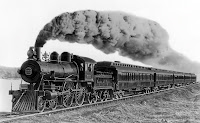
This was a very enjoyable and interesting trip, but when John returned home he learned that his cattle were dying. They were choking to death. Drought had caused the grass to wither and the watering holes to disappear, leaving white alkaline fields of sunbaked earth. John saw the remaining cattle standing motionless, flies buzzing over their bony backs, heads down, their tongues hanging from their partially opened mouths. Many were too weak to stand. It was a sickening sight, but nothing could be done to save the starved animals. Sick at heart, John turned his horse and rode wearily away. For the next two years John worked tirelessly until he was finally able to buy fifty head of cattle and a few horses. He rarely spoke of his loss and saw it as only a small setback.

In the meantime, he met a cute young amateur actress from Orderville who was performing in a play in Kanab. John played the organ in the orchestra for the dance after the show. Consequently lively Rhoda Jensen met John Rider. On a horseback riding date, John let Rhoda ride his best horse “Babel”. When he asked her how she liked the horse, she replied, “It’s wonderful. I would like to have a horse like this for my own.”  John told her that the girl who became his wife could have her. Rhoda replied, ''All right, she belongs to me." And so they were engaged. They were married April 24, 1894, in the beautiful St. George Temple.

My Uncle Irven was the eighth child born to this couple. By the time of his birth the family had moved from Kanab, to Basalt, and then to Woodville, Idaho. His father, John, served as the bishop of the Woodville ward for many years. The family later moved to Blackfoot where Irven was raised and educated.

I know more about Uncle Irven now, from learning about his roots, having grown on a family tree with roots of obedience to the call of the Prophet, hard work, sacrifice, and family values.

Monday, June 1, 2015

Hog Hollow

When I wasn't even looking for it, I ran across a picture of "Threshing at Hog Hollow". I love that name of a location which is quite famously known as the birth place of Elmer Aaron Beard, my grandfather.


Local lore explains the name "Hog Hollow" this way: 

Once upon a time, Hog Hollow was overrun by rattlesnakes causing a lot of grief for ranchers who had to ride spooked horses as they rounded up frightened cattle grazing in the meadows.  Actually, the ranchers didn't care for the snakes any more than the horses or cows did.

Annoyed by this ongoing struggle, the ranchers discovered that pigs were unharmed by the snakes, as the high fat content of their flesh absorbed the venom. The warning rattle of the snakes didn't bother hogs in the least.

The ranchers, who were not only trying to feed their families, but were businessmen to boot, soon replaced the cattle with hogs, who became the grazers of choice. This solved two problems - providing meat for the families and since the pigs were unafraid of the snakes, they stomped and killed the rattlers. Soon the  snakes were gone. 

These swine were not as domesticated as the pig Arnold Ziffel we used to love on Green Acres. In fact, they were quite wild and without the sport of snake hunting to entertain them, they began terrorizing the ranchers' children.

This would not do, and as bacon was rather popular, there are no longer pigs in "Hog Hollow".

Believe it or not, but that's the local lore.


Double Family Connection


May 29th is a red letter day in history. My sister, Sharlene McCracken Smith shares this birthday with Mary Hannah Beard Birch, although Sherry came along ninety-one years after Mary’s birth in 1860 in Whaley Bridge, Derbyshire, England.


Not only is Mary the sister of my Great Grandfather James Thomas Beard Sr., she is also the Great Grandmother of Neil Kay Birch, my sister Sandi’s first husband.


Mary Hannah Beard Birch

Mary’s parents were converted to the LDS church in England and immigrated to the U.S. when their baby daughter was not yet two years old, sailing on the ship “John J Boyd”, leaving Liverpool April 23, 1862, and arriving in New York June 1st, a relatively short journey of five weeks.


One of the Beard family’s sailing companions, William Lindsay, recorded the following in his journal:


  • "When the letter came from Liverpool telling us passages for all our family had been secured on the sailing ship John J. Boyd and telling us to sell everything we would not need on the journey and come to Liverpool in site of three days to get on board the ship which would sail April 22, 1862. This letter caused great rejoicing. Brother Sam ran around the house shouting, "Boys this is the best letter ever came to our home." 
  • ... a fairly good passage over the sea. However, we had one quite hard storm that shook things up some, but no great damage was done. Of course, the ship was being tossed about and was lurching badly. Two women right close to us were very much excited and crying. I could not help smiling although I had to keep a hold of the bunk to keep from being thrown out. I thought it absurd to suppose that a ship with 700 Saints bound for Zion could possibly sink."


By the time of Mary's immigration to the U.S., Thomas Birch, born in West Bromwich, Staffordshire, England had already arrived in Utah in the Ellsworth and McArthur Handcart Company of 1856.


In March, 1878, Mary and Thomas met and were married in the Endowment House in Salt Lake City and moved to Willard, Utah. Thomas was twelve years her senior. Three years earlier he had married Sarah Jane Vernon who had died shortly after the childbirth of their first child. The infant daughter passed away seven months later.


The young groom must have been fearful when nine months later, almost to the day, a son was born to Mary, but this time the birth was joyful. Thomas was once more overcome with grief when their second child died as an infant. Seven more healthy children joined the family.


I like this family photo from 1899. Mary is the one wearing the stylish hat and holding an infant. This photo of the family together was very precious as the following year Mary’s husband passed away at the young age of 52, leaving Mary (40) to provide for and rear the seven unmarried children. 

The oldest son, James, had married the year before and would have been a great assistance on the farm as he and his wife continued to live in the family home.
Mary pressed on operating the family farm, hiring help when necessary to assist with hauling hay or other tasks.

Mary was single for the remainder of her life, but was rarely alone. Her home was open to everyone. For a period of time one of the community school teachers lived with the family in exchange for tuition. As other children married, several lived in or near the family home in Wilford, Idaho.

Mary died at the age of 87 in Rexburg, Idaho.