Monday, March 18, 2019

Like Father, Like Son, Choice Men


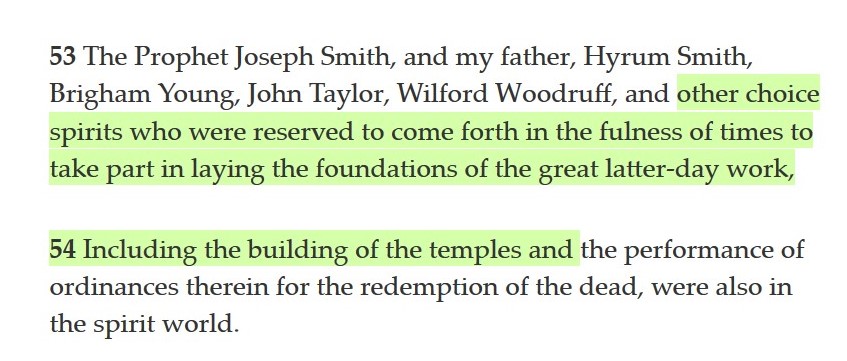
In his opening address at the 89th Semiannual General Conference of the Church of Jesus Christ of Latter-day Saints, on October 4, 1918, President Joseph F. Smith declared that he had received several divine communications during the previous months. His account of these visions became Section 138 of the Doctrine and Covenants.  Verses 53 and 54 of that section speak of choice spirits :
My Great, Great Grandfather, Frederick William Hurst, Sr. and his namesake, his son, Frederick William Hurst, Jr., are among those choice spirits.
Both very talented master craftsmen, they consecrated their skills and great artistic talents in finish work, painting and carving in temples of the Lord, including the Logan Utah, Salt Lake City Utah, Cardston Alberta Canada, and Mesa Arizona Temples.


To prepare for this work, Frederick William Hurst Jr. was called as a temple missionary in 1878, at the age of 18, to go to Boston to study portrait and decorative painting. This he did without purse or script and upon completion of his studies, he returned home to Logan to work on the temple until its completion and later in its renovation.


Left: John P. Holmgren and Frederick William Hurst Jr. painting gold leaf in the Logan Temple in the renovation of 1915.


A Logan City newspaper article also recognized Brother Hurst for his “ceiling decorations.” Other contributions of the Hurst’s were the large ornate carved hardwood chairs which were placed in the very sacred sealing rooms of the temple.


Frederick Jr. had a great interest and talent in math and calculus, which qualified him to design and construct the four corner spiral stairways in the Logan Temple and he later envisioned and created spiral stairways of black walnut in the Salt Lake City Utah Temple.


Frederick Sr. wrote of a motivating experience during their time working within the sacred walls of the Salt Lake Temple:

 
“In the fall and winter of 1892-93, I worked at painting in the Salt Lake Temple. Although sick, I felt strongly impressed to go and do my very best.


Wilford Woodruff
At noon the third day after beginning, President Wilford Woodruff called all of the of the workmen together. He said he had been told that some of the workmen had stated that it would be impossible to have the temple completed by April 6th. He said when he looked at this body of men, he didn’t believe a word of it. “Some of you may be sick and weak” (I thought he was talking to me). He continued, “Some of you may be give out at night, but you will be here in the morning if you are faithful. You are not here by accident, you were ordained in the Eternal World to perform this work. Brethren, I will be here April 6th to dedicate this building. I know what I am talking about for this was shown me in a vision 50 years ago in the city of Boston.”

Great, Great, Grandpa Hurst penned the profound impact this experience had upon him: “At times during that winter I was so sick with vomiting I dare not ride on a street car. I had two miles to walk to my lodging … often the brethren would say to me, “You can’t go to work tomorrow.” I thought of President Woodruff’s promise and didn’t miss a day all winter but was constant until the work was finished.”


The Temple was completed and dedicated, as foreseen, on April 6, 1893, by Wilford Woodruff.


Besides being artisans of the highest quality, father and son were also sincere believers in temple worship and ordinance work. Frederick Sr. served as an ordinance worker in the Logan Temple. Due to his profound hearing loss, Frederick Jr.'s service was as a dedicated patron for many years.

  
I feel very privileged to belong to the family of these choice men.

Thursday, February 21, 2019

A Mother's Influence is Eternal


"Lizzie" Hurst
My great grandmother, “Lizzie” Bateman Hurst, passed away January 8, 1902, leaving behind her husband, Samuel Harris Hurst, and nine children, ranging in age from 22-day-old Howard, to seventeen-year-old “Harry”.

Her remains were buried in the family plot in Logan, Utah, next to two more children who preceded her in death. 

An old friend of the family, a Scandinavian convert, spoke at her funeral service, giving a comforting answer to what was troubling many in attendance. He told the gathering,


“Many are asking, ‘Why should this mother be taken?’ I want to tell you that this woman shall have more influence over her family than if she had lived, and I prophesy that these children shall all grow up to be honorable men and women and shall be an honor to their parents’ name and remain true to the principles of the gospel.”


During childbirth, knowing that her days were numbered, Lizzie asked the woman attending to the birth to make sure the infant was cared for. Grandma Wright, as this woman was known, thought Lizzie was giving her little Howard. Meanwhile, Samuel’s employer, Mr. Harris, and his family believed that the child was their responsibility. Baby Howard was sent back and forth between the two homes and was well cared for.

In later life, Howard vividly recalled an experience when he was only a toddler of two or three years. He was standing on the landing of the stairs and saw his mother. Although he had never seen her since his birth, he recognized her and ran downstairs, announcing, "I seen my own dear mommie." Of course, they were skeptical that such a thing could happen, but he described her and her clothing in enough detail that they believed him.


Later, as Howard grew, he began to learn some bad habits from the rough farmhands that he worked among. About this time, a woman came to speak at his school. Since there wasn't a hotel in town, she boarded in the home where Howard was living. When she left, she spoke with Howard and gave him a book called, "Ethics of Success". She signed the book, Alice Cosgrove. Reading this inspiring book changed the direction of Howard’s life. He saw the error of his ways and resolved to be a better person. Howard believed that this event was fulfillment in his behalf of the prophesy given at his mother’s funeral. He was certain that his mother had sent Mrs. Cosgrove to him with that powerful book.

Howard summed up his mother's influence from the spirit world in this way:

"I was once asked how my mother could affect us more dead than alive, and I said that others could hide from their parents and do shady things, but I never knew when my mother was watching me.” 

Howard Joseph Hurst

Tuesday, February 19, 2019

Uncle Wesley Leon Hurst - A Sweet Man

Grandma and Wesley


Grandma Ethel Speas was the eighth born in her family, the second daughter. Her sister Nora and her brother Conrad had passed away before Grandma could meet them, leaving six children in the busy family. When she was two and a half years old, Grandma was thrilled at the birth of a little brother, Wesley, her own little doll to hold and feed. As Wesley grew they became best buddies and playmates. Decades later, it was clear to me, that for the rest of Grandma's days, Wesley was her favorite sibling. 

Ethel and Wesley's mother died when Wesley was only three and a half years old.  Little Wesley was cared for by his grandparents for a time, until his father remarried when Wesley was five. Their father followed their mother to the spirit world seven years and one day after her passing. Wesley stayed to help provide and care for his stepmother and family until he graduated from the eighth grade at age fourteen, at which time he found employment and went out on his own.

Wesley playing  with his young children
The stories Grandma told me about Wesley convinced me that he was nearly perfect. Apparently, his children thought so too. 


When he was 91 years old, his daughter Leora shared this poem at a family reunion:


God knew that there should be fathers to make the family complete.
An example to look up to and guide the little feet.
God knew there should be fathers to speak a kindly word.
To listen with attention when a child’s voice must be heard.
God knew that each and every boy needs someone close each day,
To lead with love and gentleness lest they should start to stray.
He knew each girl needs someone to wrap around her heart,
Who’d make the sun come shining through whenever tears would start,
Who’d teach his children how to smile through happy times and sad,
And so in His great wisdom, God created you – our Dad!


Wesley's Family in 1943

Wesley not only fathered his family, he was also the father, the Bishop that is, of the Springdale Ward, Burley Idaho Stake, during  the fearful days of World War II. Of this time, he wrote:
"... they were trying years. The War was on and very difficult to officer the ward with so many leaving for service, but some way we made it through."
During this time food was rationed, beginning with sugar, for the first time in U.S. history, as explained in the newspaper article, Why "War Ration Book No. 1"? by Richard M. Boeckel:


"War Ration Book No. 1 - first in the history of the United States - will shortly be issued to consumers. It will limit their purchases of sugar - beginning around the middle of March - to 12 ounces per individual per week. Use of sugar by industrial consumers has already been limited to 80 per cent of the amounts they used in 1941 and will be further restricted after family rationing is placed in effect.
The reasons for sugar-rationing are fairly well known to the American people. Japanese occupation of the Philippines has cut off the supply formerly received from that source. Sugar cargoes from Hawaii will be cut about in half by the need to conserve shipping, and by the diversion of labor to military work. Considerable amounts of sugar must be used to meet minimum requirements of other nations fighting the Axis, and some may be sent to Mediterranean countries and the Near East to replace supplies formerly received from Japan.

Sugar experts assert that very much larger supplies of sugar can be obtained than the amounts estimated by the Office of Price Administration, but large quantities of labor, materials, machinery, rail transportation and shipping-space would be needed to raise the supply to the 1941 level of consumption. In these circumstances, Washington may be content to allow present conditions of shortage to continue for an indefinite period."
 

 Wesley's family saved one of their  partially used ration books:


As his daughter Leora poetically concluded, times of want and sorrow add beauty to life that could not be seen otherwise:


Your life was not always sunshine – not all light and joy and cheer,
You have had your share of worries and days of doubts and fear.
Seems like life is just a pattern like patches on a quilt, 
And the bits of shade and sunshine are the squares on which its built.
All the sunshine squares are pretty, and the shadow ones are plain,
But you know just how much brighter is the sunshine seen through rain,
And you know the pretty patches simply never would be seen,
Were it not for all the plain ones sewn so neatly in between.